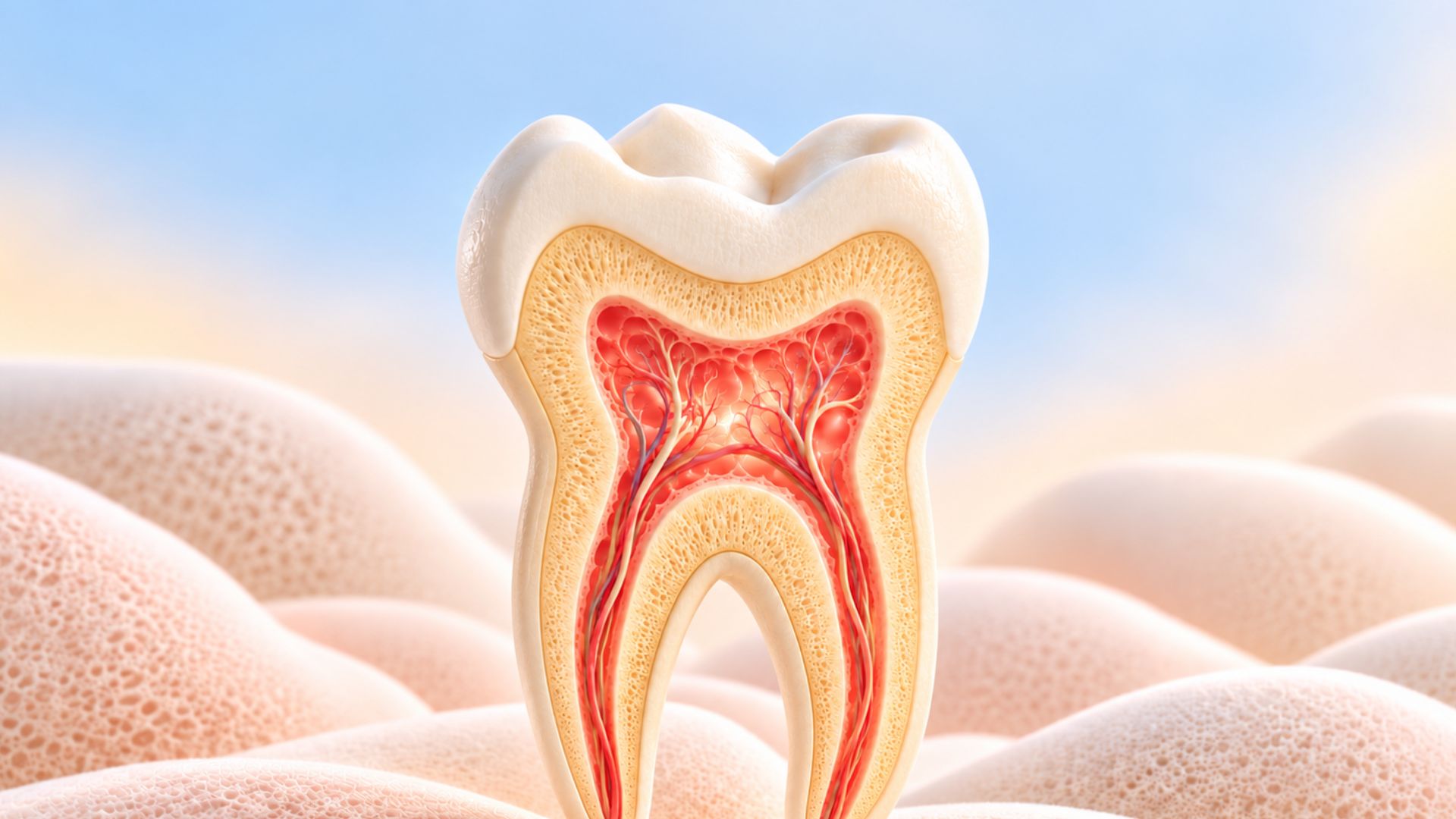
We tend to think of tooth decay as a cavity. A small hole, perhaps a filling, and that's the end of it. But the process is a little more complex than that.
Every tooth is made up of different layers, each with its own structure and purpose. And understanding those layers helps explain why some areas of decay can be managed without drilling, while others may need a filling, root canal treatment or, in more advanced cases, tooth removal.
It's not simply about how large a cavity looks on the surface. What matters is how far the decay has progressed, which structures are affected and whether the tooth can be predictably repaired.
Your mouth is home to hundreds of different types of bacteria. Many are a normal part of your oral environment, but some can contribute to tooth decay.
These bacteria live within a sticky film called dental biofilm, more commonly known as plaque, which continually forms on your teeth.
When bacteria in plaque break down sugars and other fermentable carbohydrates from food and drinks, they produce acids. Those acids can cause minerals, particularly calcium and phosphate, to leave the tooth's surface. This process is called demineralisation.
Fortunately, your mouth has a natural defence system. Saliva helps neutralise acids and supplies minerals that can be returned to the enamel. Fluoride also supports this repair process, known as remineralisation.
Throughout the day, your teeth experience a balance between losing and regaining minerals. Problems develop when acid attacks happen frequently enough that mineral loss begins to outweigh repair. Over time, the enamel can weaken and decay can develop.
Early decay doesn't always cause pain or produce a visible hole.
Enamel is the hard, mineral-rich outer layer covering the crown of your tooth. It's the hardest substance in the human body, designed to withstand the demands of everyday biting and chewing. But despite its strength, enamel isn't indestructible.
Repeated exposure to acids produced by plaque bacteria can gradually remove minerals from its structure. In the earliest stages, this may appear as a chalky white area on the tooth. At this point, the surface may still be intact. And this is where early detection can make a real difference.
When enamel has lost minerals but hasn't developed a physical cavity, the process can sometimes be stopped or reversed through remineralisation.
Depending on the individual situation, management might include fluoride treatments, improvements to brushing and interdental cleaning, dietary changes or other preventive measures.
Once the enamel surface has broken down and a cavity has formed, however, the missing tooth structure cannot simply grow back.
Enamel contains no nerves, so early changes can occur without causing sensitivity or pain. That's one reason why waiting for a tooth to hurt isn't a reliable way to determine whether decay is present.
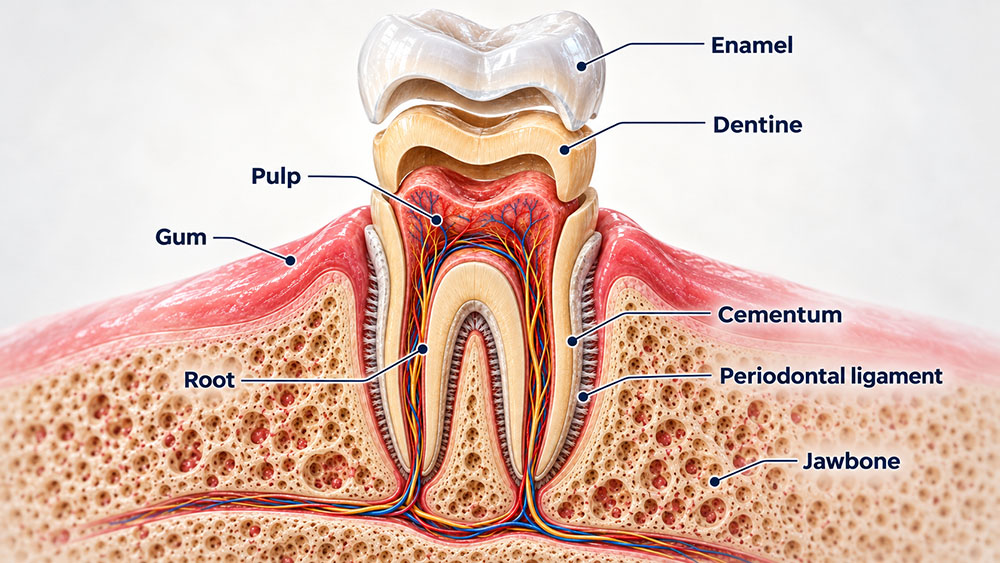
Directly beneath the enamel is dentine - a living, responsive mineralised tissue that makes up most of the structure of your tooth. It's softer than enamel and extends through both the crown and roots.
Unlike enamel, dentine contains thousands of microscopic channels called dentinal tubules. These communicate with the pulp inside the tooth and help explain why exposed or affected dentine can become sensitive.
When decay progresses through the enamel and reaches dentine, it may spread more readily because dentine is less highly mineralised.
You might begin noticing:
However, dentine decay doesn't always produce noticeable symptoms either.
Treatment depends on the depth, activity and extent of the decay, as well as whether the tooth surface has broken down.
Some carefully selected areas of dentine decay can be managed using non-restorative approaches, while others require a restoration.
Where a filling is necessary, the aim is to manage the decay while preserving as much healthy tooth structure as possible.
This is why modern dentistry focuses not only on treating cavities, but also on understanding and managing the disease process that caused them.
At the centre of your tooth is the pulp.
The pulp is soft, living tissue containing nerves, blood vessels and connective tissue. It occupies a chamber within the crown and continues down through narrow channels inside the roots, called root canals. These tissues help support the tooth during development and provide sensation.
When decay progresses deeply enough, bacteria and their by-products can irritate the pulp, even before decay physically reaches the pulp chamber. This can lead to inflammation, known as pulpitis. In its earlier, reversible stages, the pulp may still be capable of recovering once the source of irritation is treated. For example, a tooth might experience a brief response to something cold or sweet that settles quickly after the stimulus is removed.
If the inflammation becomes more severe, however, the pulp may no longer be able to recover.
Symptoms can include:
Not everyone experiences the same symptoms, and severe pulp disease can sometimes occur without significant pain.
If the pulp becomes irreversibly inflamed or infected, treatment may involve root canal treatment to remove the affected pulp tissue and preserve the tooth.
In cases where the tooth cannot be predictably restored, extraction may be necessary.
Reaching the pulp doesn't automatically mean losing the tooth. The important question is whether the tooth can be successfully treated and restored.
The roots are the portions of your teeth that sit below the crown, anchoring them within the jawbone. Unlike the crown, which is covered by enamel, the outer surface of each root is covered by a thin, mineralised layer called cementum. Beneath the cementum sits dentine, while the pulp continues through the root canals.
The periodontal ligament connects the root surface to the surrounding bone, helping support the tooth and absorb the forces involved in chewing.
Normally, the gums cover the upper parts of the roots. However, if gum recession exposes a root surface, that area may become more sensitive and vulnerable to decay. This is known as root caries, and it can develop differently from decay on the enamel-covered crown because root surfaces are less resistant to acid attack.
An infection originating inside the tooth can also spread through the root canal system towards the tip of the root. If infection develops in the surrounding tissues, a dental abscess may form. This can cause pain, swelling, tenderness when biting or other symptoms, although not every infection is immediately painful.
A dental abscess requires professional assessment and treatment.
One of the biggest misconceptions about tooth decay is that pain is the first warning sign. In reality, the relationship between decay and pain isn't that straightforward. Enamel contains no nerves, so early mineral loss generally causes no discomfort. Dentine is more sensitive, but decay can still progress within it without obvious symptoms. As the pulp becomes irritated or inflamed, sensitivity and pain may become more noticeable. However, symptoms vary considerably between individuals and teeth.
The absence of pain doesn't necessarily mean the absence of disease. This is why regular dental examinations matter, even when everything feels normal.
A dental examination involves more than looking for visible holes. Your dentist may assess:
The tooth surface: Looking for changes in colour, texture, surface integrity and areas where plaque tends to accumulate.
Existing dental work: Checking fillings, crowns and other restorations for signs of deterioration or possible decay around their margins.
Dental X-rays: When clinically indicated, X-rays can help identify decay between teeth and provide information about how far a lesion may extend beneath the surface.
Your symptoms: Sensitivity, pain when biting, spontaneous pain or discomfort that lingers can provide important clues.
The health of the pulp: Where deeper decay is suspected, additional tests may help determine whether the pulp is healthy, inflamed or no longer vital.
Dentists consider these findings together. X-rays alone cannot always establish exactly how a tooth will respond or which treatment it needs.
The overall aim is to understand both the extent of the problem and the most appropriate way to manage it.
Not necessarily. This is one of the most important developments in our understanding of modern caries management.
When tooth decay is detected before a cavity forms, there may be opportunities to stop or reverse the process by encouraging remineralisation.
Depending on the clinical situation, this might involve:
If the tooth has developed a cavity that traps plaque or has lost significant structure, restorative treatment may be needed.
For deeper decay, treatment decisions become more individual. A dentist may consider techniques designed to preserve the pulp where possible, while more advanced disease may require root canal treatment.
The guiding principle is to preserve healthy tooth structure whenever it is safe and appropriate to do so.
- Preventing decay is about maintaining the balance between the factors that damage teeth and those that protect them.
- Brush twice daily with fluoride toothpaste. Fluoride strengthens enamel and helps repair early mineral loss.
- Clean between your teeth every day. Floss or appropriately sized interdental brushes can help remove plaque from places a toothbrush cannot easily reach.
- Be mindful of how frequently you consume sugar. Repeated sugary snacks and drinks throughout the day create additional opportunities for acid production.
- Choose water regularly. Water helps rinse away food debris, while saliva plays an important role in neutralising acids and protecting enamel.
- Pay attention to dry mouth. Reduced saliva can increase the risk of decay. Some medications and medical conditions can contribute to dryness.
- Keep up with dental examinations. Your dentist can recommend an appropriate examination interval based on your individual needs and risk factors.
Small, consistent habits can make an important difference over time.
Every tooth has its own intricate structure, and every layer has a role to play. Enamel protects the crown. Dentine provides strength and transmits sensation. The pulp contains the living tissues at the centre. Cementum and the supporting structures help anchor and protect the roots.
When decay develops, understanding which structures are affected helps guide the treatment options available. But the most important point is that tooth decay isn't always an inevitable journey from a small spot to a serious problem.
When identified and managed appropriately, early decay can sometimes be stopped before a cavity develops. And when treatment is necessary, the goal is to protect your oral health and preserve your natural teeth wherever possible.
If you're due for a dental examination, or you've noticed a change that's concerning you, get in touch with our team to arrange an appointment.